
Have you ever been lying in bed, dreading getting up and driving to a job you hate? I know I have, and today, I’m going to share my experience with three different jobs that had me feeling miserable.
Job #1 – Nightmare Catalogs
I was hired as a customer service representative for a catalog company. My job was to take orders and process refunds. The company I worked for sold everything from slippers to glow in the dark snowflakes you could put on your windows during Christmas time. The products we sold had stunning pictures in the catalog, but were made cheaply overseas. Therefore, customers were disgruntled when they opened their package and saw a product that looked nothing like the one in the advertisement. It seemed like as soon as they got their item, they called our phone line and demanded a full refund.
What made this job different from your average customer service job, though, was that most of the company’s clientele were senior citizens. That meant most people I spoke with were hard of hearing. It was rare for me to make it through a call without having to repeat myself multiple times. The most common words I heard all day were “What?” “Say that again, please,” and “I didn’t hear you.” Now I’ve spent my entire life taking care of my Grandparents, so I’m used to speaking loud. However, communicating over the phone proved to be a challenge, and I constantly had to raise my voice. After working there for a while, I even started talking loudly outside of work.
I would be having a conversation with a friend, and they would say, “Daniel, why are you yelling?” I would lower my voice and then explain I spoke loud because the clients I worked with had hearing problems. Regardless, I began making a conscious effort to speak at a normal volume when I wasn’t at work.
Despite the communication barrier, working with elderly people could be highly entertaining. Most of our customers had a great sense of humor about the crappy products we sold. One customer informed me that he received his glow in the dark snowflakes but wanted to know why they didn’t glow in the dark. Another client proclaimed that the slippers he got in the mail were “made of plastic.” My supervisor showed me the slippers he ordered, and I almost died of laughter when I saw how poorly they were made. In the catalog, they looked like something you’d find in Nordstrom, but the actual product looked more like something you’d find at the 99 Cent Store.
After working for a catalog company, I’d never order from one. I’m not sure why you’d even want to these days since you can order pretty much anything from Amazon faster and cheaper. I think catalog companies target older people because they tend to be more susceptible to attractive pictures and bold product claims. If your parents or grandparents decide to order from a catalog company, be sure to research the company thoroughly before placing an order. When I eventually checked out the reviews for my company, I unsurprisingly found that they were all terrible. People could’ve saved their time & money by doing a quick Google search, and I could’ve saved myself a year-long headache.

Job #2 – Cable Company
My second worst job was being an Inbound Sales Representative for a major cable company. My position entailed selling Cable, Internet, and Home Phone Services to people who called in.
Before I started selling, though, I had to complete three weeks of group training. Our class taught us about the company’s various services, and our instructors taught us how to use the computer software. The services were easy to understand, but the CRM was complex. It was ridiculously hard to use, and most of my class struggled to learn it. Thankfully, when it was time to take the final, we all passed and were transferred to the main call center.
The trainers then informed us we’d be answering live calls under supervision for the next few weeks. If we showed competence at the end of that period, we’d be given an official seat on the sales floor. Everyone was initially nervous and needed help every other second, but ultimately, we all made it to the next phase. By then, though, I realized this job would be way more difficult than I had anticipated, and I’ll tell you why.
When I applied for the sales position, I knew selling Internet service would be easy, but I hadn’t considered that the world was moving away from Cable and Home phone service. So I was in for a rude awakening when I began answering calls, and most people started the conversation by saying, “Hi Daniel, I’m calling in today to get Internet service only and no Cable or Home phone.” I could sell customers the Internet service by itself, but I was graded on my ability to sell bundled packages and not standalone services. Additionally, every call was being monitored to ensure that I was pitching all three products to customers.
I always did my best on the phone, but selling Cable and Home Phone service was tough. On top of that, the company didn’t make things easy on us with their clunky systems. I’ll give you a complete breakdown of all the challenges I faced on the job.
Challenge #1 – Selling Cable Service
When people started trying streaming services like Netflix & Hulu, they realized they could watch their favorite shows on demand for less money. There was no need for a technician to drill holes in their wall and deal with an expensive cable bill. When I spoke to customers, and they brought up the benefits of streaming, it was hard to rebuttal them because, deep down, I knew they were right. They were getting a superior product that was cheaper and more convenient.
I noticed that my success in selling cable usually depended on the customer’s age. If I answered the phone and the client sounded young, they usually had no interest in Cable. More likely than not, they were tech-savvy and knew all about streaming. On the contrary, if I spoke to an Adult who’d been using Cable their whole life, my chances of selling it significantly increased. They were familiar with the service and not ready to try streaming… at least not yet.
Challenge #2 – Selling Home Phone Service
I felt like a huge clown whenever I spoke with a customer and brought up home phone service. It was hard for me to sell a product I knew most people had no interest in. Before I could even finish saying “Home Phone,” customers would interrupt me and tell me they weren’t interested. You would think I insulted their mother the way they responded.
The only thing that helped me sell the Home Phone service was a promotion my company offered, which allowed customers to bundle it with internet service and receive a discount. Their wireless router had a port at the back if customers wanted to plug in a landline. Most people I spoke to didn’t have a Home Phone but wanted the discount, so they agreed. When clients requested Home Phone service, it was usually for their parents, not themselves.
Challenge #3 – Phone Que
When I started answering calls, I was under the impression I would only be speaking with new customers – boy, was I wrong. Most calls I took were from existing clients who wanted to speak with Customer Service or Technical Support. The worst part? Before transferring them, I had to scan their account for missing services and try to upsell them.
This led to frequent arguments with clients who just wanted to be transferred and didn’t want to discuss adding Home Phone service when their cable box wasn’t working. It was very awkward, and if I didn’t convince them to add additional service, it counted against me on the sales report.
Challenge #4 – The CRM
The company’s computer software was terrible. Even for the most straightforward order, you had to go through multiple screens and enter a ridiculous amount of codes – it felt like you were trying to solve a Calculus equation. It was also plagued by bugs that forced you to restart your computer mid-call or sit there unsure of which codes to use, while customers waited impatiently on hold. I was embarrassed when one time I was setting up service for a customer, and he told me, “I had no idea getting internet took this long.”
It was so broken it felt criminal the company was making us use it.
Before I took this job, I was unaware that Cable companies were hated by consumers, but after working for one, I understand why. The long wait times, misleading advertising, and frequent price hikes make service providers infuriating to deal with. As a result, every day was draining because most people I spoke with were mad.
I felt like a firefighter trying to put out all these fires as customers brought up a barrage of complaints. Not to mention, all the while, I had to sell them services that were on their way to becoming extinct.
There’s no way to beat around the bush, this job sucked.
Job #3 – Telemarketing

My worst job ever was working as an appointment setter for a home improvement company.
I ended up working as a telemarketer because I quit my job one day and needed to quickly find another gig. I saw an advertisement on Craigslist for a local Sales position and called to set up an interview. When I went in to speak with the sales manager, we had a great conversation, and he hired me on the spot. I arrived at work on the first day and walked into the main room, where there were about 40-50 people. There was clearly no dress code, and the office was mixed with both young and old people. The room was filled with rows of computers, and everyone was talking on the phone. My manager was assisting someone, so I had to wait a few minutes. Once he was done, he escorted me to my desk at the back of the room.
I sat down, and my manager grabbed a co-worker to train me. My colleague came over and explained that my job was to book appointments for people interested in home improvements or repairs. He gave me a script to read on the phone and showed me how to use the computer’s dialing system. Everything seemed easy enough, and I confidently told my trainer I was ready to get on the phone.
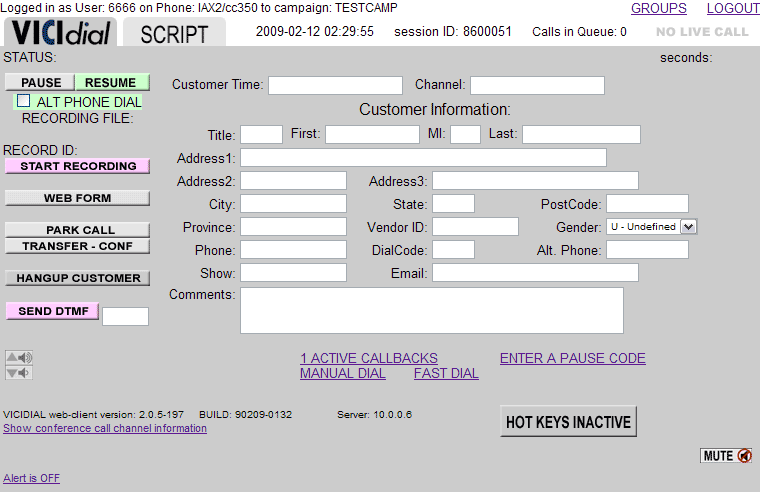
I began dialing, and as soon as someone came on the line, I started my introduction.
Me: Hi, this is…
Client: Click
Before I even got to my name, the person had hung up on me. The dialer quickly connected me to someone else, and my next call ended the same way. As soon as the person realized I was a telemarketer and not a family member or friend, they immediately ended the call. I spent the remainder of the day trying to book appointments, but I had no success. I went home that day feeling beat up and brain dead from all the rejection.
I arrived early the next day and grabbed some coffee before returning to the battlefield. I observed a few top performers in the room and noticed they all had an abundance of charisma on the phone. One guy sounded like he was a licensed contractor, and one girl was damn near yelling at people and demanding they book a free estimate. I don’t know how she did it, but she was booking appointments all day. I wasn’t about to take her yelling approach, but I knew I needed to adjust my pitch.
I started reading my script more passionately and researched home improvement outside of work, so I was more knowledgeable on the phone. I learned over time that as long as I kept my energy high throughout the day, I would speak to at least a few people interested in booking an appointment. I never knew when that person would show up, so I did my best to answer every call enthusiastically. Even the ones that came in towards the end of the day, when I was worn out after answering hundreds of calls.
It wasn’t easy spending most of the day getting hung up on, but since I had a lot of cool co-workers, it was bearable. Our office was like a circus, and it was filled with all sorts of characters. There was no background check or drug test at this company, and as long as you could talk, you were eligible for hire. We had musicians, actors, drug addicts, and even felons. Fights would break out in the office, and people frequently got caught using drugs in the bathroom.
You never knew what to expect when you came into work.

The most fascinating part of this job was dealing with the main manager, who was a guy we’ll call Fred. Fred was a bulky guy who wore black sunglasses and the same outfit every day. He was an odd but funny guy, and his sales meetings were unlike anything I’d experienced before. We would meet in the center of the room, and the normal lights would get turned off, and a disco light would come on. Then our supervisor beat on a drum while everyone stomped their feet and banged their hands against the wall. After hearing the commotion, he’d come out of his office and make the type of entrance you’d expect from a Roman emperor or celebrity.
During the meeting, Fred went over the company’s recent sales. If the estimates we set up were converted into a signed contract, he’d announce our name and the cost of the client’s project. Us agents always crossed our fingers and hoped he would announce our name and a large dollar amount. From what I recall, my biggest deal was around $200,000. I felt like a king when he announced my sale that day, and the room erupted with applause. I walked to the center of the room and hit the gong as everyone slapped my hand and congratulated me.
We had a ton of fun at these meetings, and they were the best part of our day.

Compensation-wise, we got paid close to minimum wage, but they were supposed to give us a “bonus” for the deals we helped close. If the customers’ project cost under $10,000, they gave us $10; if it was over $100,000, they gave us $100. It was a pretty pathetic commission plan, and collecting our bonus was challenging because of the lengthy sales process and shady management team. You didn’t get paid until the project was complete, which could take months, and there was no way to track the status of your deal. You had to trust the management to be honest about paying your commission, which my Co-Worker Oscar explained was a bad idea.
He told me that one time, he went to management to check on one of his commission payments. They informed him that one of his clients backed out of the deal, and he wouldn’t be getting his bonus. He had a hunch they were lying, so he called his client to verify the story. It turned out they hadn’t canceled the deal and had recently finished construction at their house. After he found out, he made a big scene and got paid, but he never trusted them again.
I had my own struggles collecting commissions during my tenure, but eventually, I stopped fighting with management over it. Every time I tried to discuss my bonus with my manager, he became angry and pointed out the days I hadn’t met my sales quota. Then he reminded me they could fire me, but since they liked me, they let it slide. I had to accept defeat and come to terms with the fact that I could only count on them for my hourly pay and not a penny more.
I started to not like working there, and my relationship with the manager began to deteriorate. Once I became a top producer, he’d always promise me a promotion, but never followed through with his words. One day, I even overheard him talking about all the employees, and he was basically calling us losers behind closed doors. It hurt to hear him say that, and I began to see things for what they really were. They didn’t care about us, and this was just a boiler room designed for him and his friends to make as much money as possible.
To further Illustrate how much they valued us, I’ll share a story.
One day, the company had us get off the phones for a brief meeting. The management team then told us they appreciated our hard work and wanted to throw a company picnic. The plan was to work a half-day on Friday and then head to a local park to play games and eat. It sounded great and caught us off guard since we all thought the company didn’t care about us. We left the meeting pleasantly surprised and couldn’t wait for the event.
On the day of the picnic, we clocked out early and made our way to the park. Everyone was in good spirits and ready to enjoy the nice summer day. We hung out, ate food, and enjoyed each other’s company. At the end of the day, everyone headed home happy and ready to enjoy the weekend. However, we had no idea that a huge plot twist was about to unfold. The following Friday, our supervisor was passing out paychecks, and I overheard people complaining that their checks were short. When I got my check, I looked at it and noticed I hadn’t been paid for a few hours. It seemed like the hours I was missing were equal to the length of our picnic.
The whole room started to demand answers as to why our checks weren’t their normal amounts. Our supervisor then came to the center of the room as a riot began to ensue. He looked nervous and explained that the company clocked everyone out when we left for the picnic and stopped paying us for the day. All the money the company saved by clocking us out early was used to pay for the picnic. It was outrageous to hear because the managers made it seem like they were throwing the picnic out of the goodness of their hearts. It turned out they deviously paid for the picnic with our own money.
People in the room started yelling things like “I have rent due” or “I needed that money for my kids.” One of my coworkers even said that if he had known his check was getting cut short, he would’ve rather worked the whole day. I was about to speak up, but I looked around and saw so many people yelling that I realized my voice wouldn’t have even made a difference. My superior apologized to the room and admitted he should’ve told us we wouldn’t be paid after we clocked out early. People began to demand their money, and some of my colleagues even became hostile. It was an ugly scene, and everybody left work furious.
The next day, Fred was there at the start of our shift, which was odd because he usually arrived in the afternoon. He then informed us that everyone would get paid for the hours shorted on our check. Our supervisor then gave him a list of people who were rioting the day before, and they were sent home and suspended from work. We were happy to get paid our missing money, but the whole incident left a bad taste in everyone’s mouth.
After this situation, I reached my apex of unhappiness and began looking for another job.
I had fun working there for the first few months, but over time, it got tiresome. Speaking to hundreds of people a day and mostly getting hung up on was draining. On top of that, our office was gloomy and filled with outdated computers, dirty carpets, and old desks. I had a lot of great co-workers to help ease the pain, but I felt like for every quality person they brought in, they hired three weirdos. I even found out that one of the guys sitting near me had been convicted of touching a minor, which was disturbing. It was apparent that this company targeted the dregs of society. People who were likely never going to be successful or achieve anything in life.
I knew that wasn’t me, and it was time to go.
It took me a couple of months, but I finally found another job and got to leave this dreadful place. I found out years later from a co-worker that the building we worked in was burned down in a fire. I can’t say I was surprised to hear that because, towards the end of my tenure, I felt like every morning I was walking straight into hell.
Make a one-time donation
Choose an amount
Or enter a custom amount
Your contribution is appreciated.
Donate

 You Can't Stop A Person With The Heart Of A Lion
Enjoyed reading about your personal experience. Your writing skills are outstanding.
LikeLike
Appreciate the compliment Harold. Thanks for reading 👊🏽.
LikeLike